
Customer onboarding
Templated plans per product tier, customer milestones visible to the customer, go-live tied to the Opportunity.


Prepared the Helio Telecom kickoff template and scheduled the meeting.
Flagged Dana at 100%+ booked and queued a rebalance request.
Flagged the Northwind site survey delay and drafted a customer update.
1 of 8 urgent items complete.
Tackle Next TaskProposed next steps for Helio Telecom — review before this goes live.



 Meeting Summary Agent
RUNNING




+
+
Bring Salesforce Opportunity and customer information into delivery.
Configure resources, milestones, dependencies, and timelines.
Apply the right project template based on what was sold to your customer.
Delegate tasks to teams, customers, and agents to complete work.
Track risk, project health, milestone progress, and critical path.
Analyze project and portfolio performance to improve the delivery process.


 ARARARAR

Hello Brittany, you’ve been assigned a TaskRay task. Finished? Click Mark Complete to let the team know.
AR
30- %
%
%


 Connection point
TaskRay MCP
Where AI and people meet: governed tools any model can call, on behalf of the humans it works for


 Agentic Project Management
System of record
 Projects & TemplatesRepeatable plans launched from Opportunity or Case
 Tasks & MilestonesDependencies, critical path, approvals
 Resources & CapacityRoles, skills, allocation, utilization
 Time & BudgetTime entries, budget burn, margin
 Views & AnalyticsMy Work, Gantt, Kanban, revenue KPIs
 Northwind Global Rollout
My WorkGanttKanban
Live in Salesforce
# northwind-delivery

Templated plans per product tier, customer milestones visible to the customer, go-live tied to the Opportunity.
Long cycles, dependencies, critical path.

Field teams, sites, equipment, sign-off.
Multi-site waves, franchise openings, services engagements with revenue recognition on the line.
Up to %
.5x
x
%


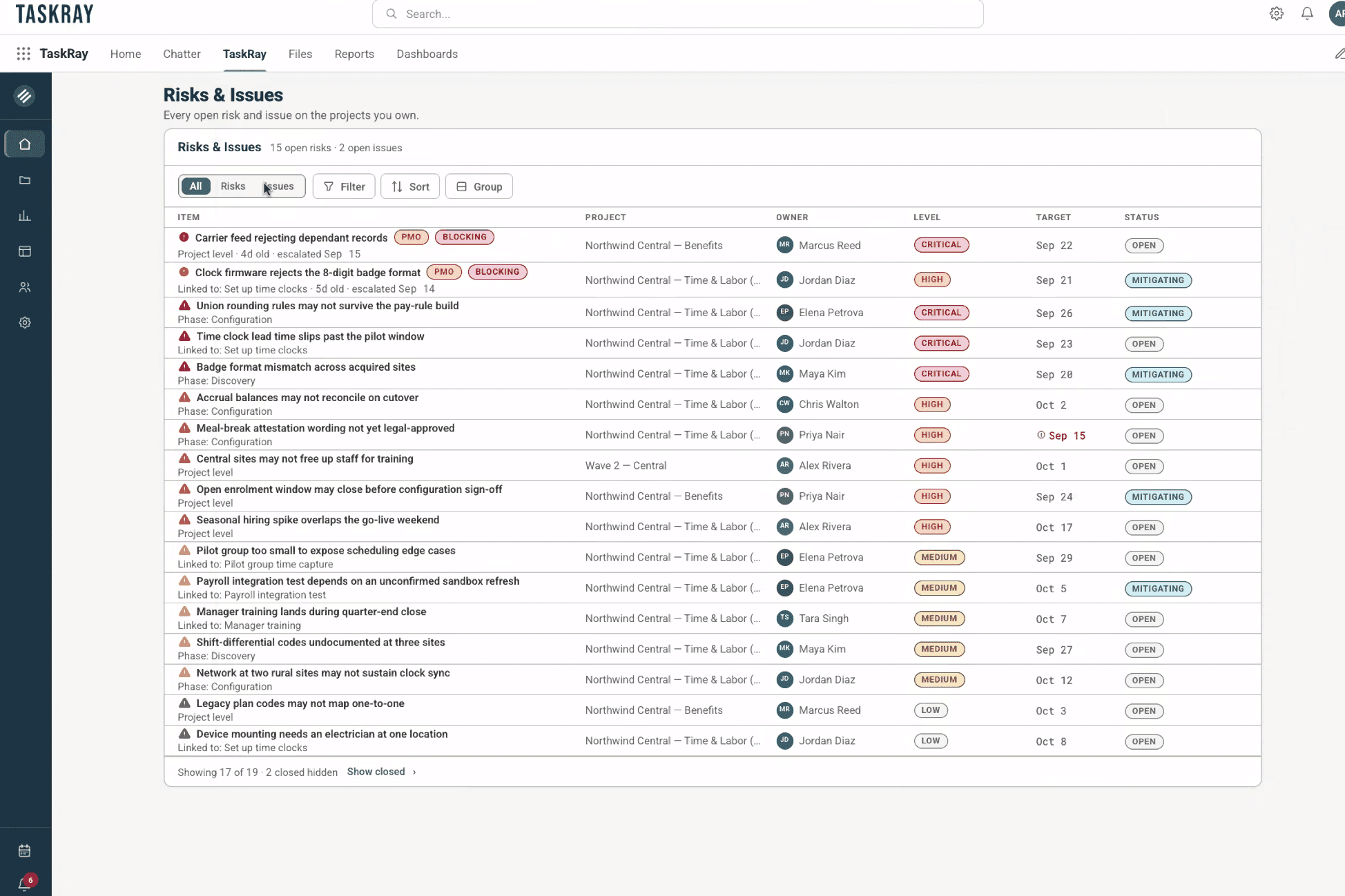
Agentic Project Management combines human expertise with AI agents that can understand project context, recommend actions, and help complete work.
Instead of relying entirely on people to update plans, prepare reports, identify risks, and coordinate routine activities, agents can support these processes using live project data. People continue to provide judgment, direction, approvals, and customer leadership.
Traditional project management tools are static by nature, primarily organize tasks, timelines, and project information for human management. They still depend on people to continuously interpret the data and move work forward manually.
Agentic Project Management adds an intelligent execution layer. Agents can monitor delivery activity, surface risks, summarize progress, recommend next steps, and help complete approved actions across the project lifecycle.
No. Agentic Project Management is designed to make project managers more effective, not replace them.
Agents can handle repetitive administrative work and help project managers identify issues earlier. This gives project managers more time to manage stakeholders, resolve complex problems, tackle a larger volume of projects, support customers, and improve project outcomes.
TaskRay provides the project system of record that people and agents use to coordinate delivery. It stores the plans, tasks, milestones, dependencies, risks, customer information, and delivery history agents need to understand the project.
TaskRay also provides MCP connectivity, purpose-built agents, Salesforce-native automation, and services for organizations that want to create custom agentic workflows. This empowers project managers to work with TaskRay from LLM chat experiences like Claude CoWork, ChatGPT, Gemini, Agentforce and Microsoft Copilot.
TaskRay can apply the same Salesforce permissions, sharing rules, workflows, and business logic to actions performed through agent experiences.
Organizations can determine which activities agents may perform automatically, which actions require review, and which decisions remain exclusively with human users. This supports a human-in-the-loop approach to project execution.
