

TL;DR: A mutual action plan is a shared document, not a project plan, that defines milestones, ownership, and success metrics before delivery work begins. The handoff from sales to delivery is where scope, commitments, and customer context get lost or diluted, and a MAP launched at closed-won can capture what was promised while the details are still fresh. A MAP that lives in Salesforce as a native record, auto-launches from a closed-won opportunity, and stays current through go-live removes the manual re-entry that contributes to scope creep and delayed launches. FieldEdge by Xplor cut time-to-go-live by 40 to 50 days after standardizing their onboarding workflows in TaskRay. Track milestone completion rate and go-live on-time percentage to measure whether the MAP is working.
After a deal closes, scope items, stakeholder names, and the go-live date often sit in the CRM and in the salesperson’s notes, and delivery has to reconstruct them. A mutual action plan is meant to prevent this, but one kept in a spreadsheet attached to a kickoff email can go stale once nobody updates it after week one.
A mutual action plan is a customer-facing document, co-created by vendor and buyer, that maps actions, owners, and dates from first agreement to go-live. MAPs also go by names like mutual success plans, close plans, joint execution plans, or go-live plans, and the meaningful distinction is who sees and edits the document rather than what it is called. GTM Now lists mutual success plan, go-live plan, joint execution plan, and close plan as other names for the same document. A close plan is usually an internal seller document, while a mutual action plan is shared with and edited by the buyer, which makes it a joint commitment rather than a seller checklist.
GTM Now explains that close plans too often conclude with “Contracts Signed,” which is seller-centric behavior, while the best MAPs continue to the buyer’s outcome. The difference is one of emphasis. A close plan tends to cover the final steps to signature, while a MAP in the general sense covers the full buying journey from discovery through signature and often into onboarding and implementation. The handoff MAP in this guide starts at closed-won and runs through go-live.
In the sales-to-delivery handoff, the MAP bridges what was sold and what will be delivered, capturing scope, milestones, ownership, and success criteria before work begins. Mutual action plans keep buyers aligned during the sale, and the same logic carries into delivery: when both teams track the same milestones in the same system, scope drift and missed commitments surface early rather than at go-live.
A well-built MAP serves five goals:
The most common objection: “We already have a project plan.” The difference is scope and audience. A project plan tracks tasks and roles for the project team, and depending on the project, its audience can include sponsors, management, and other stakeholders. A MAP tracks the commitments that the vendor and the customer each own, so both sides share responsibility for the outcome.
| Dimension | Mutual Action Plan | Project Plan |
|---|---|---|
| Purpose | Align both teams on outcomes and commitments | Clarify goals, roles, and tasks for everyone involved |
| Audience | Customer + vendor delivery team | Team members, sponsors, management, customers, and external partners |
| Timing | Created at closed-won, before kickoff | Typically finalized around kickoff, using discovery outputs such as scope and roadmap |
| Update cadence | Updated as milestones complete | Updated daily or weekly by PM |
| Owner | Shared: delivery lead + customer champion | Project manager |
A MAP that never leaves the seller’s laptop is a wish list. The customer must see it, agree to it, and update it alongside you.
Launch the MAP at closed-won, not at kickoff. The window between close and kickoff is where scope often gets lost and commitments slip. Betters Agency describes the handoff as a high-risk, manual procedure in which critical information about client expectations, negotiated scope, and success criteria can be lost or diluted as it passes from sales to delivery. A MAP launching at closed-won captures what was promised while the salesperson still remembers it.
The handoff is where a lot of information changes hands and too little of it gets documented. A broken handoff can cause rework, slower onboarding, and margin loss. Delivery teams spend hours reconciling what was sold with what can be fulfilled, which erodes project economics before work starts. CPX describes an informal or rushed handover as a source of systemic execution risk from day one, because unclear commercial details such as milestones, penalties, and risk-at-own-cost clauses erode margins.
The manual copy-paste problem is the most immediate failure mode. After close, someone copies account details, commitments, and stakeholder names from the CRM into a separate tool. Fields go stale, the two systems drift out of sync, and the customer record effectively splits in two: one version in the CRM, another in the project tool, and neither is fully accurate. When sales passes scope and assumptions along verbally, they tend to resurface as scope creep and disputes weeks into delivery. A MAP pulling data directly from the opportunity record eliminates this: account name, close date, products sold, and scope commitments carry forward without re-entry.
Scope creep is a common result when commitments go undocumented. When the MAP documents the agreed scope before work begins, change requests become visible and trackable rather than absorbed silently. The conversation shifts from “we thought that was included” to “that is a change order.”
Documenting scope prevents disputes, but without milestone-level tracking, slippage still goes unnoticed until the customer raises it. Milestone-level tracking, with due dates, owners, and status visible to both teams, gives you an early warning when a milestone slips. Without that shared tracking, the delivery team’s understanding drifts from what was committed. A MAP with live milestone status helps prevent that drift.
When the customer can see milestones, owners, and dates from day one, trust builds before the first deliverable ships. A MAP that the customer can check on their own schedule cuts inbound status calls and frees delivery hours for execution work.
The table below lists six components to include in a sales-to-delivery MAP. With fewer components, the MAP becomes a task list, and with more, it becomes a project plan nobody reads.
| Component | What It Defines | Example |
|---|---|---|
| Onboarding milestones | Phase-level checkpoints both teams track | Kickoff complete, discovery sign-off, build complete, UAT passed, go-live |
| Ownership (RACI-lite) | Who owns, approves, and is informed per milestone | Delivery lead owns build, and customer champion owns data access |
| Customer and vendor roles | What the customer provides vs. what the vendor delivers | Customer: data, access, approvals. Vendor: configuration, training, support |
| Phase-specific success metrics | Measurable outcomes per phase | Discovery completion rate, UAT pass rate, go-live on-time percentage |
| Dependencies and roadblocks | Risks, assumptions, issues, dependencies documented early | Data migration depends on IT access granted by week 2 |
| Target dates | Deadline per milestone | Go-live: March 15. UAT sign-off: March 1 |
A practical way to measure these is to define each formula before the project starts. One option for discovery completion rate is the percentage of requirements-gathering tasks your team marks done by the discovery deadline, which is a working definition rather than an industry standard. UAT pass rate is passed test cases divided by total test cases executed, and go-live on-time percentage across your portfolio is projects launched by the committed date divided by total projects in the reporting period.
The MAP operates at the milestone level: kickoff, discovery sign-off, build complete, UAT passed, go-live. Each milestone is a phase gate both teams agree must be reached before the next phase starts.
Work backward from the customer’s target go-live date and schedule each phase based on how long it actually takes your team, using your own project history as the benchmark. Before TaskRay, FieldEdge by Xplor‘s go-live process took approximately 120 days, and leadership had no reporting on time from closed-won to go-live or time spent on each milestone. Build your template around the actual cadence for each customer type you onboard.
Every milestone gets one accountable owner on each side, one for the vendor and one for the customer. A common approach is RACI-lite: one accountable person per side, one or more responsible doers, plus whoever must be consulted or informed. The MAP is where both sides know who holds the next step, not the place for a full RACI matrix.
The MAP must explicitly separate customer ownership from vendor ownership. A task that each side assumes the other owns is the one that stalls the timeline. The customer typically owns data migration, system access, internal approvals, and stakeholder availability, and the vendor owns configuration, integration, training, and support.
Each phase needs measurable outcomes. Discovery tracks completion rate and requirements sign-off, and build tracks cycle time and milestone completion rate. UAT tracks pass rate and open defect count, and go-live tracks on-time percentage and stabilization metrics. Pair leading indicators such as milestone completion with lagging indicators such as retention and expansion. The MAP tracks the leading indicators, and the lagging ones reveal longer-term outcomes after go-live.
Include a RAID log: risks, assumptions, issues, dependencies. Document the signals that move the customer from one stage to the next, so the team can see when one is running late. A dependency like “customer IT grants system access by week 2” is one of these signals, and if it slips, the MAP flags it before the build phase stalls.
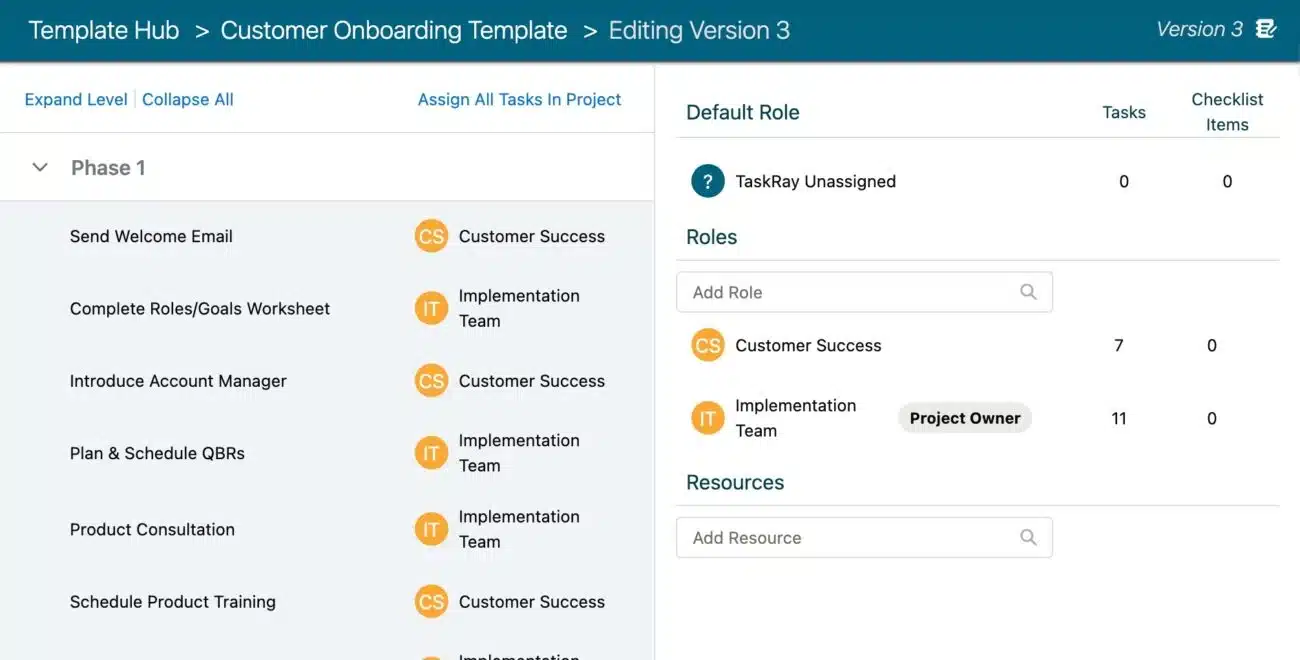
A reusable template encodes the milestone sequence once, so every new implementation starts from a proven structure rather than a blank plan.
List the standard milestone sequence: kickoff, discovery, build, UAT, go-live, stabilization. Start from successful past deals and codify the sequence that worked.
Define approval gates between phases. Before build: discovery sign-off from the customer’s technical lead. Before go-live: UAT passed, data migration validated, champion confirms readiness. Write the exit criteria for each gate into the template so both sides know what approval means.
Assign ownership at the milestone level, with one accountable owner on each side and a target date next to every milestone.
Give the customer a live view of milestones and open tasks through a shared portal or collaboration tool. The customer checks status on their own schedule instead of waiting for your weekly update email or calling the PM. TaskRay’s Collaboration View provides external stakeholders a real-time look at project plans and task statuses without additional licenses.
Encode the template as a workflow that auto-launches at closed-won. Work with sales operations to set the trigger and field mappings, so every closed-won deal launches the same MAP structure across your portfolio.
FieldEdge by Xplor cut time to go-live by 40 to 50 days after moving onboarding into TaskRay. The workflow change behind the number: flexible templates and task-level tracking replaced long lists of notes, and dashboards now show leadership the time spent on each milestone. Each implementation specialist now manages up to 25 accounts at a time, up from 12 to 15.
Copy the table below into your Salesforce project template or a shared document, then replace the bracketed placeholders with each customer’s names and dates. Keep the exit criteria as written, because they are the gates both sides agree to meet before the next phase starts.
| Milestone | Vendor Owner | Customer Owner | Target Date | Exit Criteria |
|---|---|---|---|---|
| Kickoff complete | Delivery lead | Customer champion | [Close date + X days] | Both sides confirm scope, stakeholders, and the go-live target carried over from the closed-won opportunity |
| Discovery sign-off | Delivery lead | Customer technical lead | [Date] | Requirements documented and signed off by the customer technical lead |
| System access granted | Implementation consultant | Customer IT lead | [Date] | Customer IT grants the access the build phase depends on |
| Build complete | Implementation consultant | Customer champion | [Date] | Configuration and integrations finished, and data migration validated |
| UAT passed | Delivery lead | Customer champion | [Date] | Agreed test cases passed and open defects reviewed with the customer |
| Go-live | Delivery lead | Customer executive sponsor | [Target go-live date] | Customer champion confirms readiness, and compliance sign-offs are complete where required |
| Hypercare exit | Delivery lead | Customer champion | [Date agreed in the MAP] | Exit criteria met, and the support handoff and escalation path are documented |
Each phase has different milestones, owners, and success criteria. A mutual action plan sales template that reuses one set of milestones and owners across every phase tends to fail at both ends of the project: discovery lacks the requirement sign-offs that lock scope, and go-live lacks the readiness gates that confirm the customer is prepared to launch.
Discovery turns sales commitments into documented deliverables. If sales captured that the customer’s goal is “reduce manual reporting by 80% within 90 days,” a milestone like “first automated report delivered and validated by the customer champion” ties the plan to that outcome more directly than “discovery phase complete.” Anchor each milestone to a customer outcome documented before close, so the plan measures what the customer bought rather than what the team did.
Build covers configuration, integration, data migration, and testing, with technical milestones like “integration endpoints configured” and “data migration validated.” Translate technical milestones into language the customer can follow.
For regulated industries (healthcare, financial services, insurance), pre-go-live includes compliance checks, security review, and formal sign-offs that cannot be skipped. Before full deployment, validate requirements, test in the customer’s environment, and get sign-off from the customer champion. Build these gates into the MAP as hard stops, with the delivery lead owning each one, so compliance risk surfaces as a gate rather than as a go-live surprise.
The stabilization phase (hypercare) covers the weeks right after launch, and its length varies by project, so agree on the window and its exit criteria in the MAP. It typically includes formal go-live confirmation, scheduled check-ins, and the transition to ongoing support. Document the support handoff explicitly: who owns the relationship post-go-live, the escalation path, and first-quarter success measures.
A mutual action plan onboarding template in a spreadsheet creates the same fragmentation it was designed to solve. The MAP only works if it lives in the same system as the deal data. As a Salesforce record, every milestone update and status shift is visible to sales, delivery, and leadership without manual sync.
Use Salesforce Flow to create a project from a template when the opportunity stage changes to Closed Won. The pattern has three parts: the trigger (opportunity updated), the criteria (stage equals Closed Won), and the action (create project from template). The project inherits the opportunity name, account reference, and custom fields capturing scope commitments, so no PM spends Monday morning copying data from the CRM into a separate tool.
Typical field mappings set the project name from the opportunity name, the account lookup from the opportunity’s AccountId, and an opportunity lookup that links back to the deal. TaskRay supports this motion through templates and automation: define the template once, configure the Flow trigger, and every closed-won deal launches a project with the correct milestone structure.
As a native record, the MAP inherits the org’s permission sets, sharing rules, and field-level security, with no parallel permission model. Because the project lives in the same org as the deal, the delivery lead can work from the same account data and opportunity history as sales, with access governed by the org’s existing sharing rules. TaskRay’s native vs. integrated comparison frames the difference: connected tools live in their own system and sync through a connector, while native tools create the project from the same opportunity record, so there is no sync to break.
Collaboration View gives external stakeholders live, read-only milestone status without additional licenses. TaskRay’s Collaboration Hub lets external stakeholders view, manage, and contribute to project tasks in a secure portal. Collaboration Connect takes a lighter approach: tasks can be assigned to external collaborators, who mark them complete via email without a platform login.
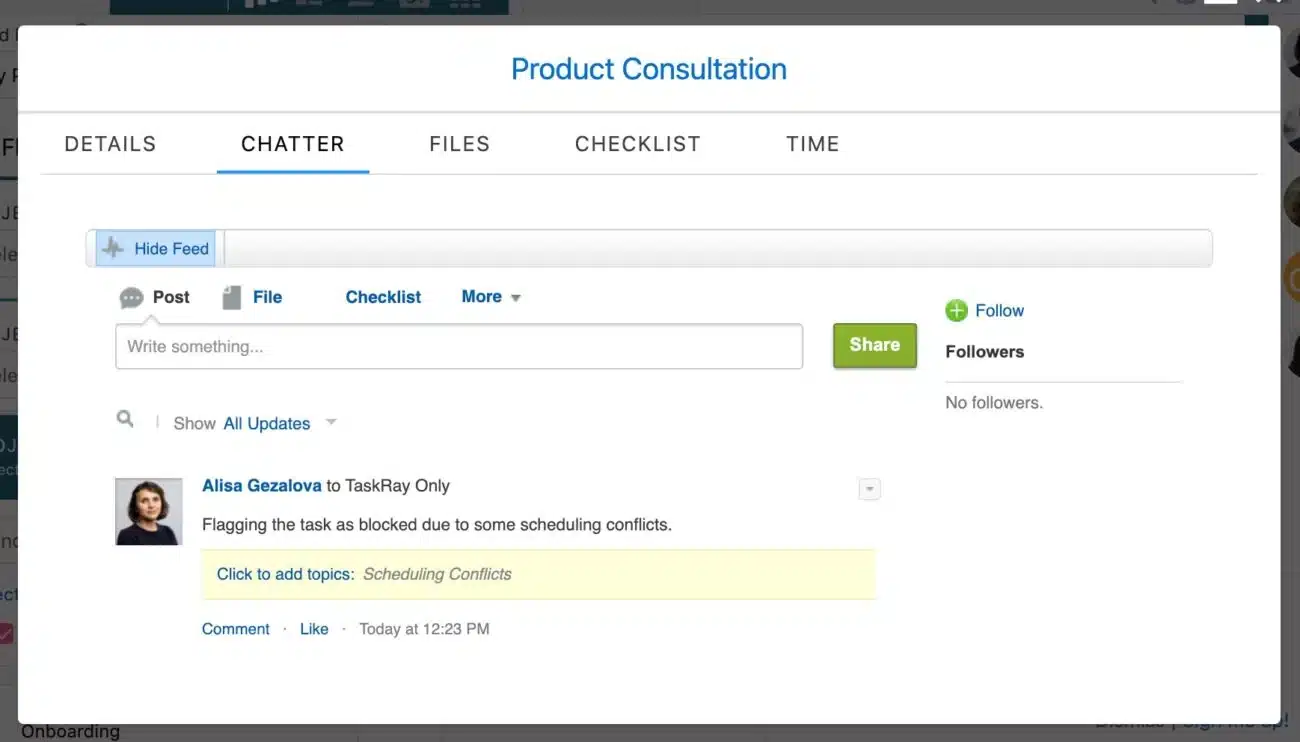
Use Collaboration View for customers who only need real-time status, Collaboration Connect when external stakeholders must complete tasks but lack portal access, and Collaboration Hub when the customer’s project team needs full read-write access to milestones and dependencies.
Because every project, milestone, and task is a Salesforce record, executives build delivery dashboards in standard Salesforce Reports and Dashboards without a separate BI tool. At FieldEdge by Xplor, TaskRay reports and dashboards now give leadership a clear view of project milestones and team performance.
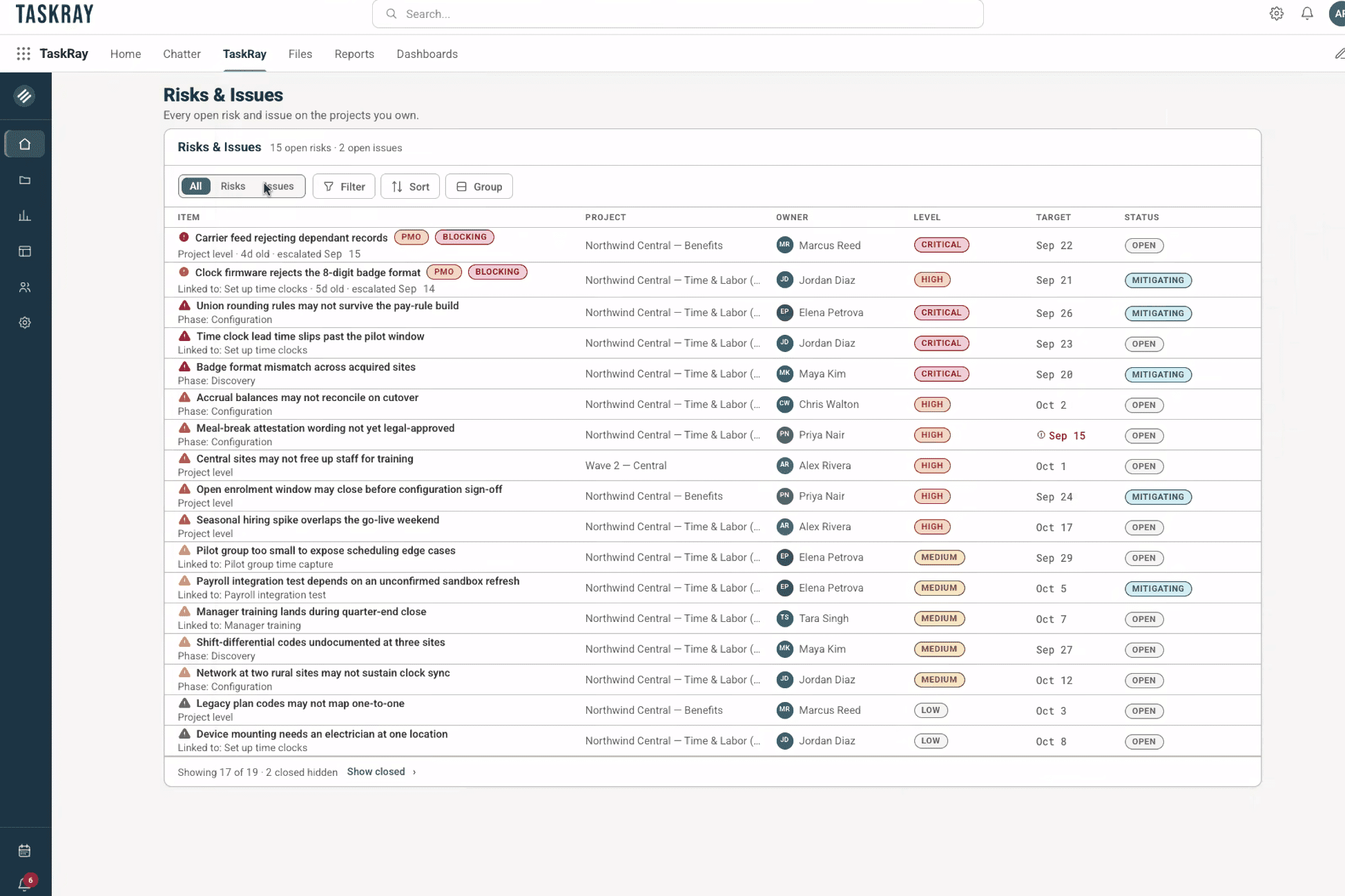
A portfolio dashboard that tracks average days-to-go-live against target shows which teams are hitting their committed go-live dates and which are slipping.
Common MAP failure modes include building the plan without customer input, drowning the plan in task-level detail, letting CRM data and MAP data drift apart, and treating the MAP as a static artifact. Avoid them structurally rather than relying on PM discipline.
A plan sellers write alone is a wish list. Forecastable identifies mapping only the seller’s milestones as the first pitfall: a plan light on the buyer’s internal steps misses where the timeline actually lives. Build the template with input from sales, delivery, and a recent customer.
Milestones give both teams a shared view, and task lists create noise. Adding too many milestones at once can overwhelm stakeholders, so keep the list to the most important checkpoints and avoid task-level detail. A MAP built on a short list of major checkpoints stays readable, while one weighed down by task-level detail is a project plan pretending to be a MAP.
The MAP must reflect the same account, contact, and opportunity data as the CRM. Vague ownership and missing dates are the obvious errors, and data divergence is the quieter failure: the MAP says one thing, the CRM says another, and nobody knows which is current.
A MAP kept in a separate spreadsheet or slide deck quickly becomes just another document to maintain, and updates slip through the cracks. MAPs are living documents. Updates must flow from completed milestones, not manual status meetings. As a Salesforce record, milestone completion updates the plan automatically, but as a spreadsheet, it goes stale.
A sales mutual action plan template that auto-launches from closed-won and updates as milestones complete addresses the static-document problem structurally.
See how TaskRay can help your team deliver customer projects more efficiently. Request a demo today.
A mutual action plan is a shared, customer-facing document aligning both teams on milestones, ownership, and success metrics. A project plan tracks task-level execution for the project team, and its audience can include sponsors, management, and other stakeholders.
Create the MAP at closed-won, before kickoff. The window between close and kickoff is where scope, commitments, and stakeholder context get lost.
Ownership is shared. The delivery lead owns vendor-side milestones, and the customer champion owns customer-side milestones. Both parties update the plan as milestones complete.
Keep the MAP in the same system as the deal data (Salesforce) so milestone completion can update the plan without manual re-entry. A MAP requiring manual updates in a separate tool goes stale quickly.
Yes. A well-built template encodes the standard milestone sequence, ownership structure, and success criteria once, so every customer starts from the same proven framework. Tailor dates, names, and scope items per customer without rebuilding the structure.
Mutual action plan: A customer-facing document co-created by vendor and buyer that maps milestones, owners, and dates from agreement to go-live.
Milestone: A phase-level checkpoint both teams agree must be reached before the next phase begins.
Go-live date: The target date when the customer’s solution is fully deployed and operational.
Scope creep: The gradual expansion of project requirements beyond what was agreed, often caused by undocumented commitments.
RAID log: A tracking document for risks, assumptions, issues, and dependencies that surfaces blockers before they become escalations.
Sales-to-delivery handoff: The transition point where a closed deal moves from sales to delivery, carrying scope, commitments, and customer context.
Customer collaboration portal: A secure, external-facing view of project milestones and tasks that lets customers check status and complete work without accessing the vendor’s internal project management system. In TaskRay, this takes three forms: Collaboration View for read-only status, Collaboration Hub for full read-write participation, and Collaboration Connect for completing tasks by email.

