

TL;DR: Most conversational AI pilots in Salesforce delivery operations stall for one reason: legal can’t answer who owns the audit trail. The fix is permission architecture, not a better model. Run agents as the signed-in user inside your existing Salesforce org through TaskRay’s MCP layer, so every project action inherits the permission sets, sharing rules, and field-level security your team already maintains. As an onboarding result, FieldEdge by Xplor cut 40 to 50 days from time-to-go-live after standardizing its workflows in TaskRay. Evaluate agents on which permission tier they occupy (read-only versus write-back) and whether they create a second system of record outside your compliance perimeter.
The pilot-to-production gap for conversational agents isn’t a model problem. It’s a permission problem. Your delivery teams can already ask Claude or ChatGPT to summarize project status, flag at-risk milestones, or draft resource assignments. The question for you as an AI strategy leader is whether the actions these agents take on live Salesforce records can be governed, audit-trailed, and attributed to business outcomes without creating a second permission model outside your compliance perimeter.
That question becomes harder to answer once a regulator, a customer, or legal asks who owns the audit trail for AI-initiated changes to customer project data, because the audit trail either exists by then or it doesn’t. TaskRay, a Salesforce-native project management app for post-sale delivery that runs as a managed package inside your existing Salesforce org, answers that question through its MCP layer before the pilot stalls.
Conversational project management via Salesforce MCP replaces the swivel-chair integration between chat interfaces and project records with a governed protocol. The Model Context Protocol (MCP) is an open standard introduced by Anthropic in November 2024 that gives AI applications a consistent way to connect with external tools and data sources (Descope, an identity and access management company that publishes MCP guidance).
For AI strategy leaders, the protocol matters less than the governance model it enables. When agents connect through an MCP server that runs inside your Salesforce org, they operate within your existing security perimeter rather than creating a parallel data pipeline.
You connect large language models to your Salesforce data model through MCP’s standardized interface. Unlike point-to-point integrations that require custom code for each AI assistant, an MCP server built on the Salesforce permission model exposes project actions (status reads, milestone updates, resource assignments) through a single governed layer while enforcing the same CRUD (create, read, update, and delete) permissions and field-level security that apply to human users.
Governance teams struggle with shadow AI because unsanctioned tools create invisible data flows. A governed MCP server reduces this risk by routing sanctioned agent actions through a permission-aware gateway. Salesforce-native MCP servers, including Salesforce’s own hosted servers and TaskRay MCP, authenticate each user through OAuth. The agent then inherits that user’s field-level security, CRUD permissions, sharing rules, and record-level access.
Agents acting on fragmented data produce unreliable risk flags and status summaries. When project data lives as native objects inside Salesforce, delivery data stays connected to the customer record, sales process, and support history. Agents then read from the same governed source of truth that humans use, removing the sync step where standalone tool integrations introduce reconciliation errors.
The architecture determines whether you can defend your AI deployment to auditors. When you run standalone project management tools, you create data extracts or two-way syncs that place customer onboarding data outside your Salesforce compliance boundary. MCP for project management inverts this model by bringing the AI to the data rather than moving data to the AI.
TaskRay MCP connects to Claude, ChatGPT, Copilot, or Agentforce (Salesforce’s AI agent platform). This allows your delivery teams to query project status, generate status reports, or initiate kickoff workflows conversationally without switching contexts or copying data into chat tools outside your Salesforce compliance boundary.
When an agent acts through MCP, it operates under the authenticated user’s specific CRUD permissions, field-level security, and sharing rules, enforcing the same Salesforce security model that applies to human users. If a project manager on your team can’t see the financial fields on a project record, neither can the agent acting on their behalf. This user-context inheritance anchors agent access in your existing security model, but the agent should still carry its own narrowly scoped permissions intersected with the user’s, so it never holds more authority than its task requires.
Ask your Salesforce admin to start with the most restrictive configuration that meets your use case. For TaskRay MCP, that means three controls:
Pilot in a sandbox first, and limit who can authorize the External Client App (the Salesforce connection that authenticates an external AI client into your org) before you expand access. Your role is to sign off on those requirements, not to configure them.
If you also use Salesforce’s own hosted MCP servers for other data, those offer separate controls such as Named Queries and read-only server configurations.
Every TaskRay MCP action runs as the signed-in user and is attributed to them, so the audit trail reads the same whether a person made the change or asked an agent to make it. Field History Tracking logs the old value, new value, user, and timestamp for each tracked field, which extends that audit trail. When you enable it on project milestones and status fields, you get a field-level audit trail for agent-initiated changes, retained for 18 months by default unless you add Field Audit Trail.
The absence of guardrails creates the pilot-to-production gap. AI strategy leaders need a framework that distinguishes between low-risk read operations and high-stakes write actions on live customer records.
Ask your Salesforce admin to create a dedicated permission set or permission set group named explicitly for AI access (for example, AI_Assistant_Access) and to grant permissions deliberately (GaTech Solutions, a Salesforce consultancy that covers MCP security configuration). Require read-only access and field-level security to be applied before anything connects. Add write access per object, per reason, with a record of why.
Implement a three-tier governance model:
One example mapping of agent actions to approval tiers and audit requirements:
| Agent Action | Data Impact | Approval Tier | Audit Requirement |
|---|---|---|---|
| Query project status without changing any record | None | Automated | Standard API logs |
| Prepare a proposed status update without saving it to the record | Low (staging) | Human-in-the-loop | Draft retention + approver identity |
| Change the status of a milestone on a live project record within a committee-approved scope | High (live record) | Committee review (approves the capability) | Field History Tracking + change reason |
Consider configuring human-in-the-loop approval for actions that affect customer-visible data or financial milestones. Set up agents to draft proposed changes (updated status fields, revised dates, risk flags) and route them to the project owner for review before anything is saved to the record. Salesforce approval requests reach approvers through the notifications tray, the Items to Approve list, or an email alert, but check how agent-drafted changes route to approvers in your org. This keeps accountability with a named person while limiting the review burden.
Frame your risk posture in terms of permission inheritance rather than model architecture. Explain that agents operate under the same Field-Level Security and Organization-Wide Defaults (the baseline sharing settings that determine which records each user can access) as human users, with every action logged in the same audit trail used for compliance reporting. The board needs to know which actions run autonomously (read-only status checks) versus which require human sign-off (milestone updates), not the details of transformer architecture.
Your teams will route around slow approval queues, creating shadow AI adoption when official channels move slower than business value. A BlackFog survey reported by CIO found that nearly half (49%) of workers have adopted AI tools without employer approval, and 63% believe that’s acceptable when there’s no corporate-approved option. Close this gap by establishing clear service-level agreements (SLAs) for permission tier promotions, with timing based on the risk of each tier and a defined escalation path for urgent delivery needs.
Production readiness requires moving from “agents can summarize” to “agents can execute” within defined boundaries. These workflows assume Technology & SaaS customer onboarding motions where implementation delays directly impact revenue recognition.
Configure agents to query TaskRay project records for milestone completion percentages, upcoming go-live dates, and blocker statuses, then format these into executive summaries or customer-facing updates. Because the agent reads from native Salesforce objects, the data reflects real-time changes without batch synchronization delays.
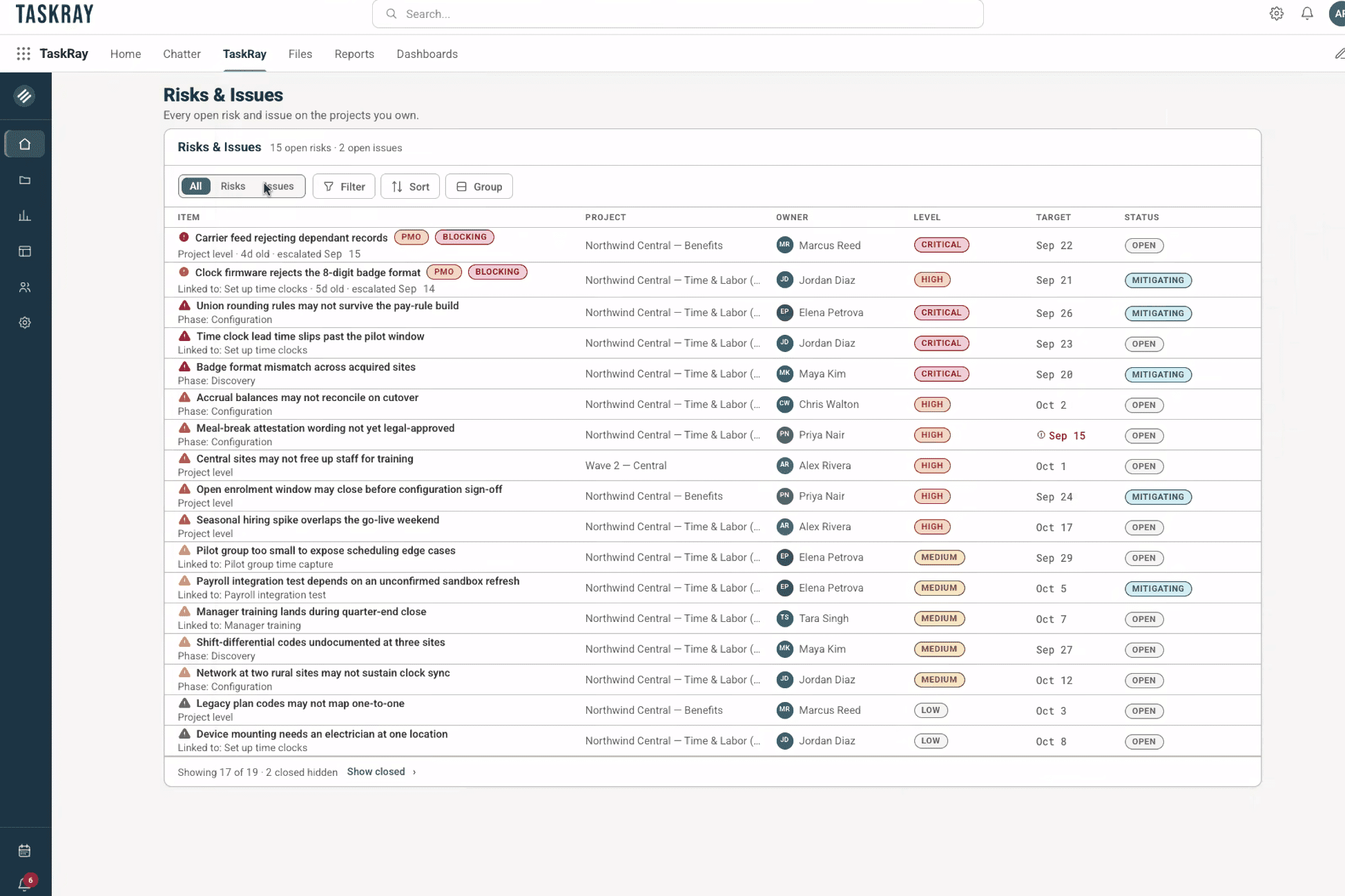
Agents excel at pattern recognition across portfolio data: identifying projects with three consecutive missed milestones, resource overallocation across concurrent implementations, or stalled customer onboarding tasks. Start with read-only access to RAID (Risks, Assumptions, Issues, Dependencies) logs and project health fields, which live on the same Salesforce records as the rest of the project in TaskRay, and limit write access to creating TaskRay tasks assigned to human project managers for investigation, so the agent doesn’t auto-update project health status. Scoped permissions support this pattern, and you should confirm the exact agent action boundary with your governance owner.
Resource reassignment affects capacity planning and billable utilization. Limit agents to recommending resource changes based on availability and skill matching, with read-only access to user records and capacity calendars, and require governance committee approval of the reassignment capability and its scope before agents update actual assignments, consistent with the committee review tier for resource reassignment. This keeps agents from creating utilization conflicts while still surfacing efficiency gains.
For customer onboarding workflows, standardize agent permissions around template-based project creation, with read access to opportunity data and write access limited to creating project records from templates. Limiting write access this way keeps every kickoff starting from the same encoded onboarding steps, so an agent can’t create one-off project structures that drift from your standard.
Define clear escalation thresholds, tuned to your delivery context, so an agent that detects a project slipping triggers a human review workflow rather than attempting autonomous correction. The agent drafts the escalation notice and identifies the critical path, but the decision to renegotiate scope or add resources remains with the delivery leader.
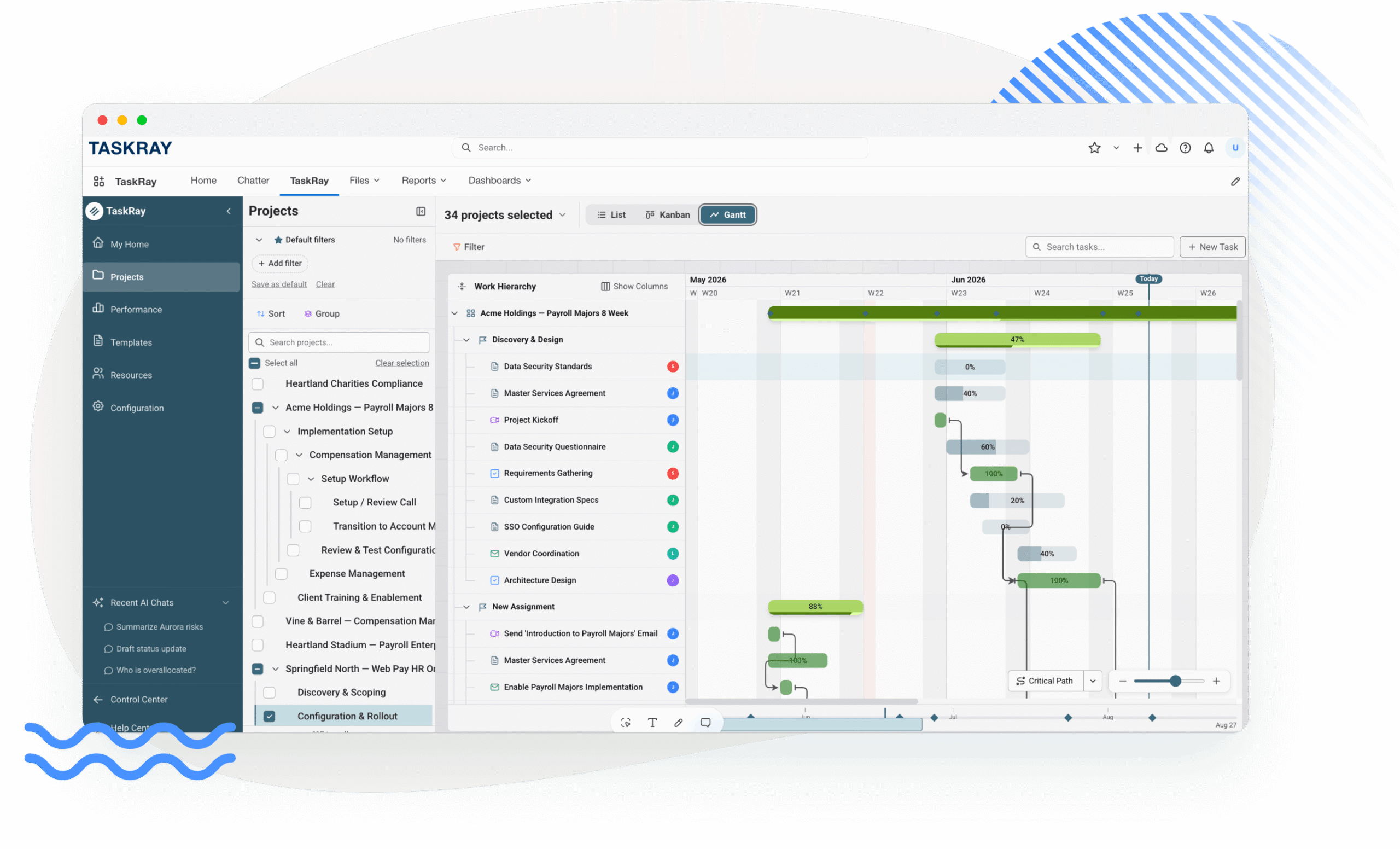
TaskRay runs as a managed package inside your Salesforce org, so the framework above applies to project records without a parallel permission model. TaskRay MCP applies the governed layer described earlier to TaskRay project records, so agents act within each user’s existing access.
Because TaskRay project records are native Salesforce objects, delivery data stays connected to the customer record, sales process, and support history without synchronization latency. For onboarding, a Flow automation can auto-launch a TaskRay project from a predefined template when an opportunity closes, using the data already in the opportunity record, and agents can create projects through TaskRay MCP on request.
Business outcome attribution separates production deployments from expensive experiments. Track metrics that tie directly to revenue operations rather than AI usage statistics.
Measure the reduction in time from deal close to project kickoff. Manual handoffs from deal close to kickoff require someone to copy account details and requirements into a new project, and TaskRay removes that step by auto-launching a project from the closed-won opportunity using data already in the record. As a pre-agent baseline, FieldEdge by Xplor cut 40 to 50 days from time-to-go-live by standardizing these workflows in TaskRay.
Track hours recovered from status compilation, meeting scheduling, and manual data entry. Toast’s customer onboarding team improved workload management and team capacity with TaskRay. Calculate ROI by multiplying hours saved by fully-loaded delivery specialist cost.
Monitor on-time go-live rates and revenue recognition timing. Track how many days earlier agents flag at-risk milestones than the weekly human status call, because earlier flags allow intervention before customer escalation. Track the percentage of projects that go live on schedule before and after agent deployment, segmented by complexity tier.
Establish baselines before deployment:
| KPI Category | Metric | Data Source | Target Improvement |
|---|---|---|---|
| Cycle Speed | Days from close to kickoff | Salesforce Opportunity + TaskRay Project | Days cut vs. baseline |
| Status Reporting Time | Hours per week on status reporting | Time tracking or survey | Hours reclaimed vs. baseline |
| Risk Flag Lag | Days between risk emergence and flag | RAID log timestamps | Days gained vs. baseline |
| Specialist Workload | Projects managed per specialist | Resource assignment reports | Increase vs. baseline |
Moving from sandbox demonstrations to live customer delivery records requires a structured governance checklist that satisfies legal, compliance, and operations stakeholders.
Start with read-only access: assign pilot users permission sets that grant read access to TaskRay project, milestone, and resource records, but not edit access. Because agents inherit the user’s permissions, the agent can query status without changing anything. This allows delivery teams to experience conversational querying without risking data integrity. Document the specific objects and fields accessible to the agent, excluding sensitive financial data or personally identifiable information not required for delivery execution.
Implement a formal promotion path: sandbox testing with demo data, limited pilot with one delivery team using read-only access, human-in-the-loop write access for non-critical fields, and finally autonomous write access for specific object types. Each promotion requires sign-off from the Salesforce security owner and business unit leader.
Avoid permission sprawl by maintaining one AI-specific permission set group, with one permission set per governance tier. When multiple teams deploy agents (customer success, professional services, support), ensure they share the same underlying permission framework rather than creating conflicting access controls across the org.
MCP enables permission-safe connectivity but doesn’t fix poor data quality. Before enabling write-back permissions, audit the opportunity-to-project handoff fields for completeness, because agents acting on incomplete data will generate inaccurate status summaries regardless of protocol security.
Set data quality thresholds for required handoff fields based on how critical each field is to delivery, and confirm those thresholds are met before authorizing write access to live records.
| Milestone | Governance Approval Required | Success Criteria | Risk Mitigation |
|---|---|---|---|
| Sandbox pilot | Governance owner review of a risk management plan agreed before the pilot starts | Agent accurately reads demo project data | Monitoring and reporting requirements defined before the pilot starts |
| Read-only access to live project records | Salesforce admin + security review | Sustained accurate status summaries over a defined review period | Read-only enforcement |
| Writes that require human approval before saving | Compliance + delivery leader | Every drafted update reviewed and approved before commit | Draft quarantine before commit |
| Agent writes without per-update approval, limited to low-risk fields | Governance committee | No corrections required over a defined review period | Field History Tracking enabled |
| Agent access across all approved object types on live records | Executive sponsor and legal sign-off where your governance process requires it | No unauthorized data access detected during the review period | Periodic permission audits |
Sandbox doesn’t mean ungoverned: agree on the risk management plan, monitoring, and reporting requirements before the pilot starts, because Gartner predicts that more than 40% of agentic AI projects will be canceled by the end of 2027 due to escalating costs, unclear business value or inadequate risk controls.
See how TaskRay can help your team deliver customer projects more efficiently. Request a demo today.
MCP (Model Context Protocol) is an open standard that allows AI assistants to connect with external tools and data sources. For Salesforce project management, MCP enables AI agents to read and act on project records within the Salesforce security model without requiring custom API integrations or a separate data store outside the org.
TaskRay MCP connects to Claude, ChatGPT, Copilot, or Agentforce (TaskRay). The connection works with any MCP-compatible AI platform while maintaining the signed-in user’s Salesforce permissions.
Agent actions execute as the authenticated user, meaning every sharing rule, field-level security setting, and object permission that applies to the human user applies equally to the agent acting on their behalf.
Sequence approvals in three steps: security review for read-only access (validating field-level security), compliance review for write access (confirming audit trail configuration), and governance committee approval for autonomous actions on live records.
Deployment timelines vary by governance maturity. A common sequence is to move from sandbox pilot to read-only access on live records first, then add write-back permissions once security review and audit trail validation are complete. Your governance process sets the timing for each step, not a fixed number of weeks. The critical path is legal approval of the permission model, not technical implementation.
MCP (Model Context Protocol): An open standard introduced by Anthropic in November 2024 that standardizes how AI applications connect to external data sources and tools, enabling conversational AI to interact with Salesforce records through a governed protocol layer.
Read vs. write permission: The distinction between agents that can query and summarize project data (read-only) versus agents that can create, update, or delete records (write), with write permissions requiring additional governance controls and audit trails.
Human-in-the-loop approval: A governance tier where agent-generated recommendations or drafted changes require explicit human review and approval before execution, maintaining accountability for actions that affect customer-facing or financial records.
Pilot-to-production gap: The compliance and governance chasm between AI pilots approved for sandbox testing with demo data and production deployment authorized for live customer data, typically requiring legal review, security audit, and formal permission set approval.
Shadow AI: The use of AI tools, features, or agents within an organization without IT, security, or procurement knowledge or approval, often emerging when official approval queues move slower than business needs, a definition drawn from Zylo, a SaaS management company that tracks shadow IT and shadow AI.

