

Every leadership team is asking the same question right now:
“How do we use AI agents to replace manual work?”
The excitement is understandable. AI agents promise a future where repetitive operational tasks disappear, workflows become autonomous, and organizations scale output without scaling headcount.
But most companies are approaching this moment like a gold rush. Everyone wants to “build agents.”
Very few organizations understand what agents actually require to do meaningful work inside the enterprise.
An agent is not just a chatbot with a task list. And enterprise AI is not simply “connect ChatGPT and automate jobs.”
The reality is much more operational.
Agents only work when they are built on top of structured systems, connected data, orchestration layers, governance models, and clearly defined workflows.
Without those foundations, agents become unreliable assistants that hallucinate tasks, lose context, fail approvals, and create operational risk.
The organizations that successfully scale enterprise AI agents will not be the ones with the most prompts.
They will be the ones with the best infrastructure.
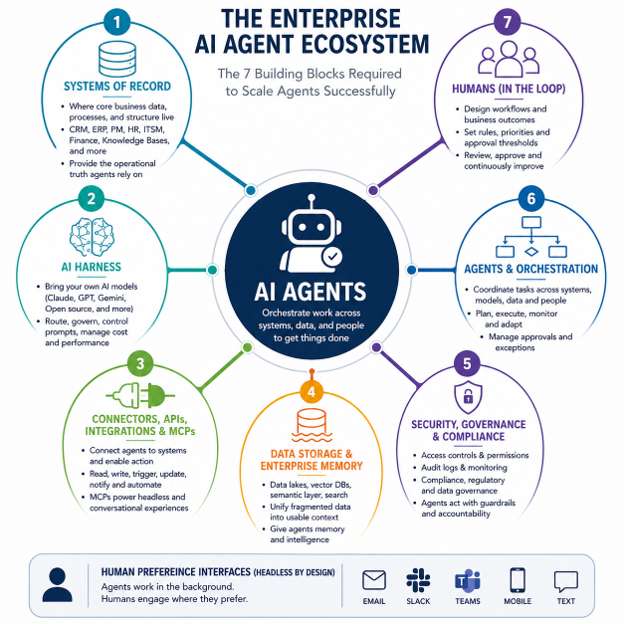
Most discussions about AI agents focus only on the AI model itself.
But the model is only one small component of the stack.
To deploy enterprise AI agents that can complete meaningful business work, organizations need foundational operational layers beneath them.
The organizations that scale AI successfully will build around seven core components.
Systems of record are where enterprise data, workflows, approvals, ownership structures, and operational processes live.
These include platforms like:
These systems define the operational truth of the business. For example:
Agents need this structure to understand:
Without systems of record, agents have no reliable context to operate from.
This is why the future of AI is not “less software.”
It is deeper investment into the systems that create structured operational data.
Most enterprises will not standardize around a single AI model forever. Think about how fast this landscape is changing. 6 months ago teams were using ChatGPT and Gemini. Now Claude is emerging as the category leader. This may change in the next few months!
Organizations need flexible orchestration layers that allow them to route workloads between:
This “bring your own AI” architecture allows businesses to optimize performance, security, cost, governance, and use-case specialization.
The winning enterprise platforms will not hardcode a single model or “harness.” They will orchestrate multiple models intelligently.
An enterprise AI agent is only valuable if it can actually take action. In order to take action, the agent needs context, data, and direction. Reading information is not enough.
Agents need the ability to:
That requires:
This is where the future becomes increasingly “headless.”
Quick definition: Headless software separates the system that manages data and business logic from the interface where people interact with it. Instead of work being tied to a single application screen, the software can power experiences across email, Slack, Teams, mobile apps, websites, voice assistants, or AI agents through APIs and integrations.
Historically, humans logged into applications directly to manage work. Now, agents are increasingly interacting with systems behind the scenes while humans work from the interfaces they already prefer:
The applications still exist underneath, but the user experience becomes increasingly conversational and orchestrated through agents in a headless manner.
Agents are effectively digital employees operating across enterprise systems.
That means organizations must define:
Permissions, audit logging, cybersecurity, compliance, and governance become critical.
In highly regulated industries, security and compliance roadblocks will significantly impact how quickly organizations can scale AI agents operationally.
AI without governance does not scale. It creates risk.
Most company data is fragmented across dozens of applications. Customer records, support tickets, contracts, onboarding notes, transcripts, analytics, and operational updates all live in different systems.
Agents need unified context to operate intelligently. Think about it like taking in a dozen different data languages and translating them into one language that can be called upon to do work.
That requires:
While this stage is not mission critical to every business, without enterprise memory, agents become isolated assistants with partial understanding of the business. This stage is a more advanced and complex requirement.
Businesses that process a lot of data that seek to build advanced enterprise AI agents and models will need this layer, but smaller businesses will not be held back without a universal memory layer.
The goal is not replacing systems. The goal is orchestrating work across systems. The goal is to start small and test.
An effective enterprise AI agent coordinates:
Agents don’t need to be super complex. They can be built to execute simple, yet time consuming tasks. For example, one of the clearest examples of this in our environment at TaskRay is how we use Gong.
Gong helps us intake meeting intelligence and visualize real-time pipeline health:
This is an important distinction in the AI conversation.
It would be unrealistic to think a few prompts connected to Claude, Zoom, Salesforce, and other systems could recreate what Gong has spent over a decade engineering.
Gong is a specialized revenue intelligence platform built around transcript intelligence, engagement scoring, pipeline analytics, forecasting signals, and relationship mapping.
That’s not “just AI.” That’s deep product specialization.
The opportunity is not replacing Gong. The opportunity is building agents on top of Gong. For example, one highly valuable workflow would be a Buyer Journey Risk Agent.
This agent could monitor:
If a deal begins showing signs of risk, such as stalled follow-ups, declining engagement, repetitive objections, or unclear next steps, the agent could automatically:
That is where enterprise AI becomes operationally powerful. Not because the agent replaces Gong, but because the agent operationalizes the intelligence Gong already provides.
One of the biggest misconceptions in AI today is the belief that humans disappear from workflows. In reality, humans become even more important.
Humans still define business outcomes, establish governance rules, approve sensitive actions, monitor workflows, optimize systems, and manage exceptions.
The future is not humans versus AI. It is humans operating through increasingly intelligent systems.
The best organizations will build human-in-the-loop operating models where agents accelerate execution while humans provide oversight, prioritization, and judgment.
Many leadership teams are now issuing a new directive:
“Stop buying software. Build with agents instead.”
But there is a major flaw in that logic. Most organizations struggled for years to operationalize workflows, integrations, governance, systems alignment, and clean data structures. Now they believe they can suddenly engineer distributed AI ecosystems overnight.
That is not how this works. The future enterprise stack will not eliminate software.
It will consolidate around fewer, more strategic systems of record with stronger interoperability and better operational data.
CRM systems, ERP systems, project management platforms, transcript intelligence tools, and operational databases become even more important in an agent-driven world.
Why? Because agents are only as effective as the systems beneath them.
The companies that win in the AI era will not simply have the best prompts. They will have the cleanest operational systems, strongest integrations, best data structures, clearest governance models, and most effective human-to-agent collaboration.
Humans will not want to live inside 15 different applications all day. Work will increasingly happen through Slack, Teams, email, mobile, and conversational interfaces.
The systems of record still exist underneath. But agents become the orchestration layer between systems and people. That is the real architecture shift happening in enterprise AI.

