

Updated October 16, 2026
TL;DR: RAID helps project teams manage uncertainty by tracking risks, assumptions, issues, and dependencies throughout delivery. As onboarding and implementation work grows more complex, traditional RAID logs can leave teams reacting too late. AI is changing that by surfacing project risks earlier, monitoring dependencies in real time, and turning RAID management into a more proactive operational intelligence system. This guide covers what RAID stands for, what goes in a RAID log, a worked example, how to run the log week to week, and where AI changes the work.
If you work in project management, customer onboarding, implementation, or enterprise delivery, you have probably heard the term RAID before.
And no, not the storage infrastructure kind.
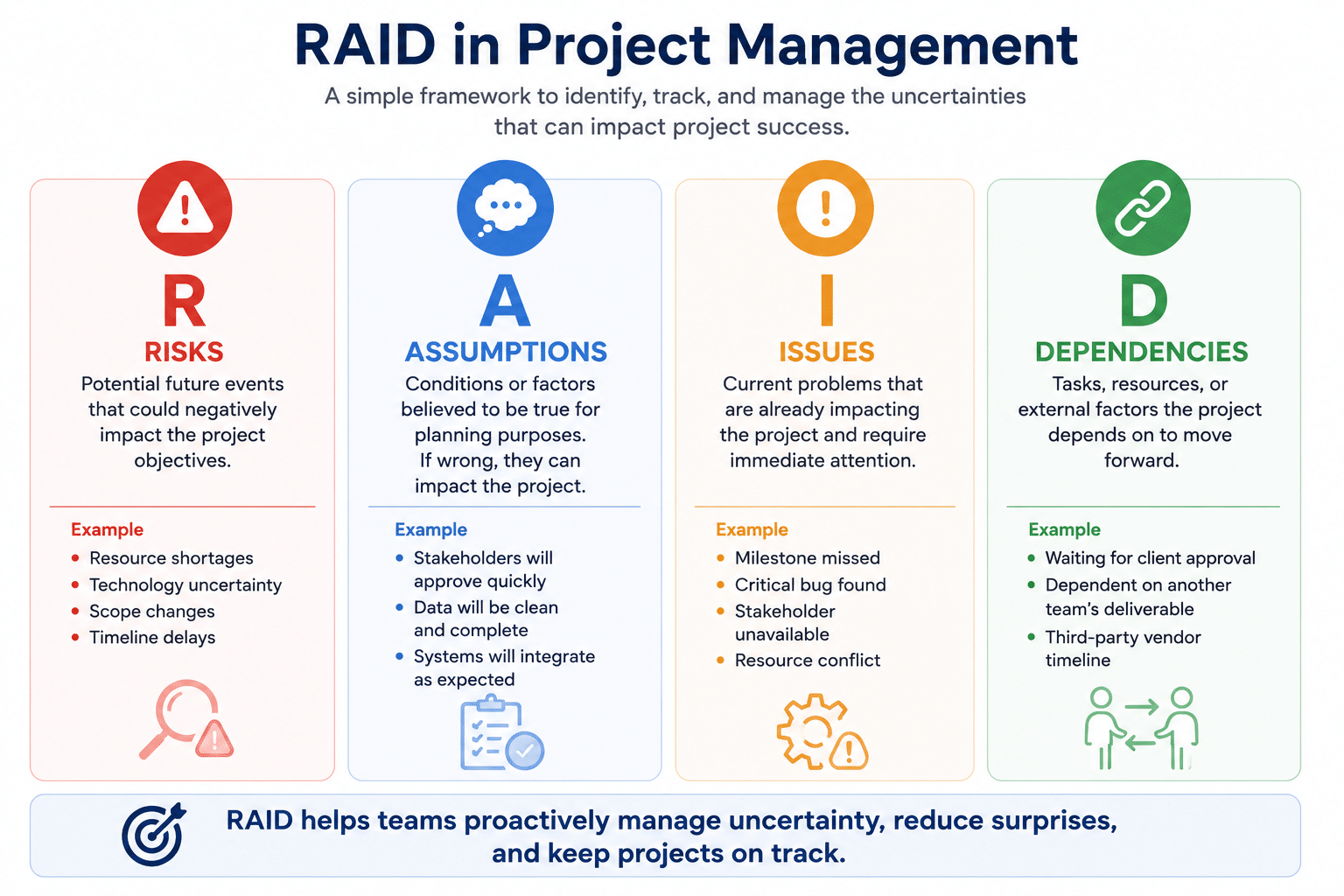
In project management, RAID stands for Risks, Assumptions, Issues, and Dependencies. It is one of the most widely used operational frameworks inside Project Management Offices (PMOs) because it helps teams manage the uncertainty surrounding project execution.
That last part matters more than most people realize.
Projects rarely fail because teams forget what work needs to get done. Most projects fail because the operational complexity around the work becomes difficult to manage. Stakeholders go silent. Dependencies get delayed. Risks are identified too late. Assumptions turn out to be wrong. Small issues compound into major delivery problems.
RAID exists to prevent that from happening.
For years, RAID management has been a foundational discipline for enterprise PMOs. But as delivery cycles move faster and organizations manage increasingly complex implementations, the way companies approach RAID is evolving rapidly. AI is beginning to transform RAID from a static reporting exercise into a real-time operational intelligence system.
To understand where project management is headed, it is important to first understand why RAID became so crucial in the first place.
At its core, RAID is a structured way for project teams to monitor project health and operational risk throughout delivery. Teams typically track all four categories in a single working document called a RAID log, covered in the next section.
Each category represents a different type of uncertainty that could impact project success.
Risks are potential future events that could negatively affect the project. These have not happened yet, but they could. For example, a delivery team may identify that resource availability could become constrained during a critical implementation phase or that a customer approval process may take longer than expected. Strong project teams do not simply document risks. They actively monitor them, assign ownership, and create mitigation plans before problems emerge.
Assumptions are conditions believed to be true for the project plan to succeed. These are often overlooked, but assumptions can quietly become some of the biggest threats to delivery predictability. Teams may assume that customer data will be clean, that integrations will work as expected, or that stakeholders will respond quickly during onboarding. When assumptions go unvalidated, projects often experience delays that feel sudden even though the warning signs were present from the beginning.
Issues are active problems already affecting delivery. Unlike risks, which represent possible future events, issues require immediate attention. An integration failure, a missed milestone, or a key stakeholder becoming unresponsive are all examples of project issues. Effective PMOs use issue management processes to escalate blockers quickly before they create cascading downstream delays.
Dependencies are tasks, systems, approvals, or teams required before other work can continue. Dependencies are one of the most common sources of operational bottlenecks because they frequently exist outside the project manager’s direct control. A software onboarding project, for example, may depend on customer security reviews, procurement approvals, engineering work, or third-party vendor timelines before implementation can proceed.
Together, these four categories create a framework for identifying the operational realities that influence project success.
Some teams expand the acronym differently. The A can stand for actions instead of assumptions, and the D for decisions and deliverables instead of dependencies. If your team also needs to track actions and decisions, add them as columns in the log rather than dropping a category.
A RAID log is the working document where a project team records and tracks every risk, assumption, issue, and dependency in one place. It is a living log that gets reviewed and updated throughout delivery, not a report assembled after something has already gone wrong.
Most teams run the RAID log as a spreadsheet, a shared document, or a view inside their project management tool. The format matters less than the habit: every item gets an owner, a status, and a next step, and the log gets reviewed on a fixed cadence.
A useful RAID log carries the same core columns regardless of the tool:
Here is what four typical entries look like in a customer onboarding project:
| ID | Category | Description | Impact | Probability | Owner | Status | Next step |
|---|---|---|---|---|---|---|---|
| R-01 | Risk | Customer’s Salesforce admin is allocated at 120% during the integration phase | High | Medium | Project manager | Open | Confirm a backup admin before kickoff |
| A-01 | Assumption | Customer data will pass migration validation on the first run | Medium | Medium | Data lead | Open | Validate a sample export in week 1 |
| I-01 | Issue | SSO configuration is failing in the customer sandbox | High | Already occurred | Solutions engineer | In progress | Escalated to customer IT, review Friday |
| D-01 | Dependency | Customer security review must clear before go-live | High | Low | Customer security team | Open | Review booked, follow up weekly |
Probability applies mainly to risks. An issue has already happened, so it carries an impact rating but no probability.
The project manager owns the RAID log. The team contributes items, but one owner keeps the categories consistent, chases updates, and runs the review.
As organizations scaled operations across departments, geographies, customers, and technologies, project complexity increased dramatically. PMOs needed a standardized way to monitor delivery risk across hundreds or even thousands of simultaneous initiatives. RAID gave organizations a common operational language for discussing project health. It gave project managers, executives, customer-facing teams, finance organizations, and delivery leadership the same current view of project health.
More importantly, RAID helped organizations become more proactive.
Without structured RAID management, teams often discover delivery problems too late. A dependency delay becomes visible only after timelines start slipping. A stakeholder issue surfaces only after customer frustration escalates. A bad assumption reveals itself only after implementation work is already underway.
RAID was designed to surface those signals earlier.
This became especially important in industries where project execution directly impacts revenue realization. SaaS onboarding, enterprise software implementation, consulting engagements, and professional services organizations all depend heavily on efficient project delivery to recognize revenue and maintain customer satisfaction.
In many ways, RAID management became the operational backbone of modern PMOs because it enabled organizations to move from reactive firefighting toward more predictable delivery management.
Even though RAID remains foundational to project operations, many organizations still manage it in highly manual ways.
That creates major limitations.
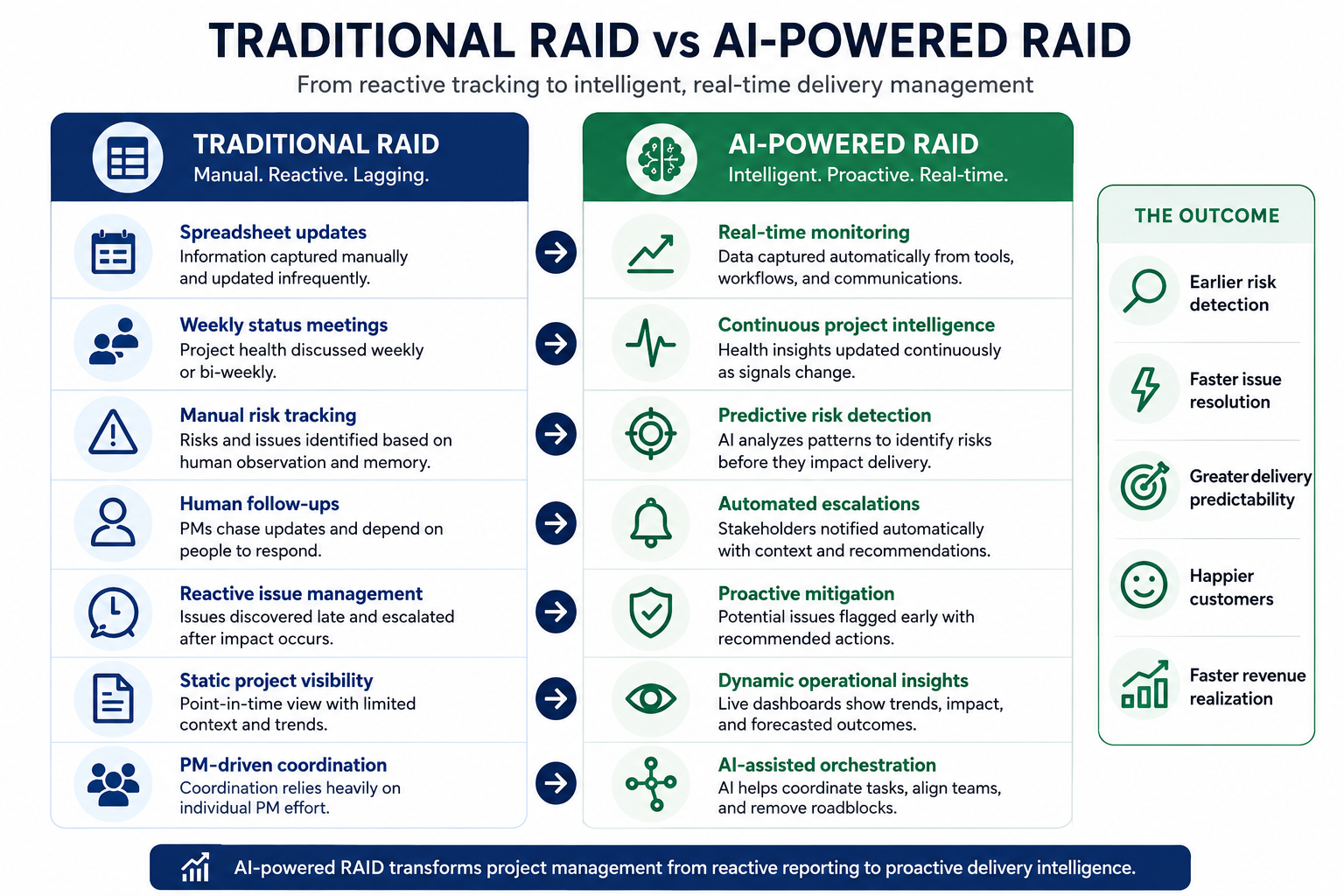
In most companies, RAID logs live inside spreadsheets, shared documents, project management systems, or weekly status meetings. Teams manually update risks, document issues, and review dependencies during governance calls. While this approach worked reasonably well in slower-moving project environments, it struggles to keep pace with modern delivery operations.
Today’s project environments are far more dynamic.
Customer onboarding teams may manage dozens of implementations simultaneously. Cross-functional delivery teams often coordinate work across sales, customer success, product, engineering, legal, security, and external vendors all at once. Priorities shift constantly. Stakeholder responsiveness changes daily. New risks emerge continuously.
By the time a human manually identifies and updates a RAID item, the project may already be drifting off track.
This is one of the biggest challenges modern PMOs face. Traditional RAID management often becomes a reporting function rather than an operational system. Teams spend significant time documenting project health after problems emerge instead of preventing problems before they happen.
The result is reactive project management. And reactive project management does not scale well in high-growth delivery organizations.
A risk register tracks one thing: risks, usually with formal scoring, mitigation plans, and governance sign-off. A RAID log covers risks plus the three other categories that derail delivery week to week: assumptions, issues, and dependencies.
The two are complements, not substitutes. Larger PMOs often keep a formal risk register for audit and governance purposes and run the RAID log as the day-to-day delivery tool. For a single onboarding or implementation project, a well-kept RAID log is usually enough.
The importance of RAID becomes even more apparent in customer onboarding and implementation environments.
Many organizations focus heavily on the sales process and assume the hardest work ends when a contract is signed. In reality, operational complexity often begins after the deal closes.
Customer onboarding introduces a wide range of delivery uncertainties. Internal teams must coordinate resources, configure systems, manage integrations, align stakeholders, validate requirements, and meet aggressive go-live timelines. At the same time, customers themselves may be managing competing priorities internally, which creates additional dependency and communication risk.
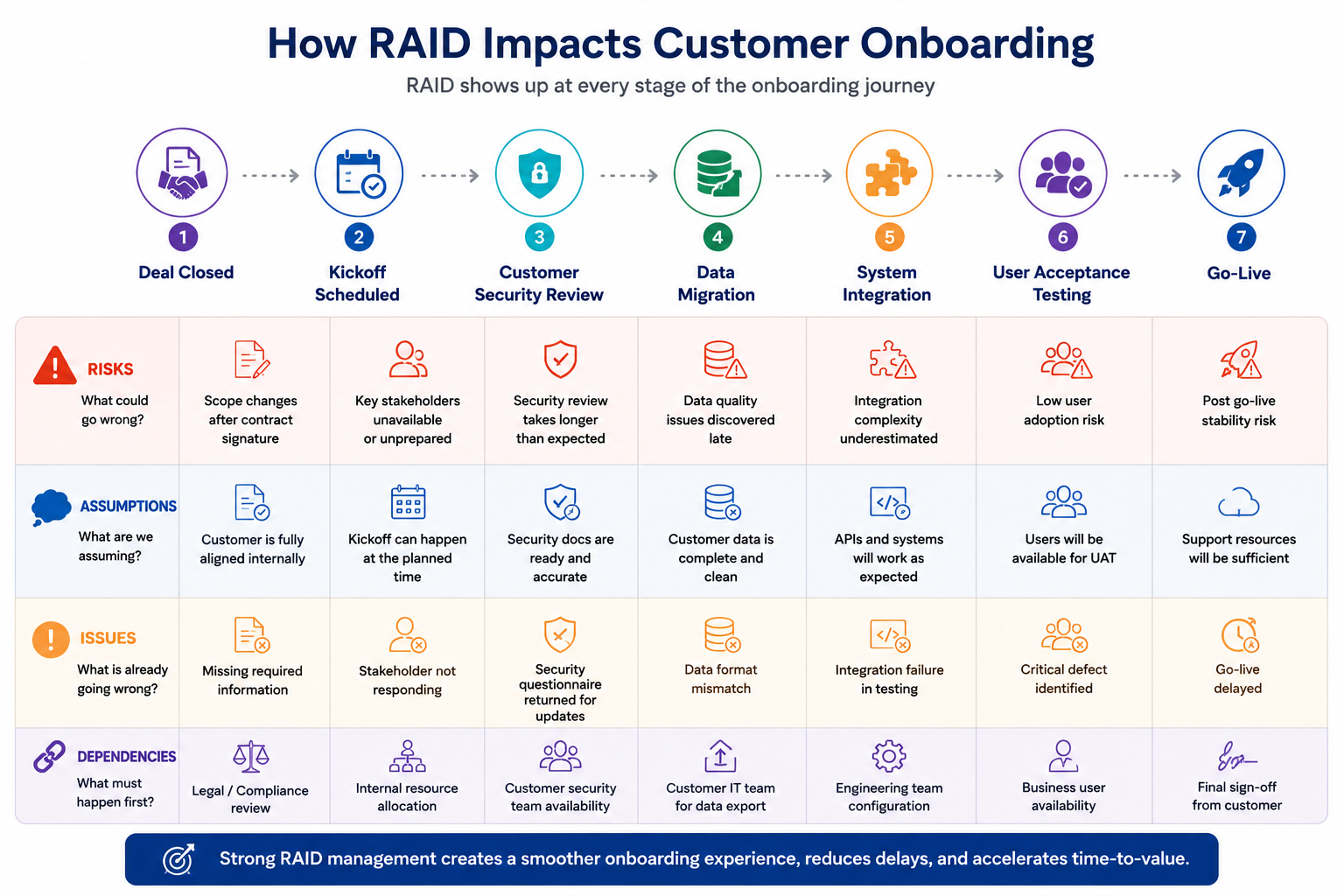
For example, an onboarding team may assume the customer’s data is ready for migration, only to discover major formatting issues weeks into the project. A dependency on customer security approval may delay integrations. A key stakeholder may disappear during implementation, slowing decision-making and milestone approvals.
Without a current RAID log, these seemingly small operational gaps can quickly lead to delayed onboarding, frustrated customers, and slower revenue realization. The cost shows up directly in the customer onboarding metrics delivery teams already track: time to go-live, milestone completion, and early churn.
As SaaS companies increasingly compete on customer experience and time-to-value, the time from signed contract to the customer’s first realized milestone, operational predictability during onboarding has become a strategic differentiator. RAID management helps organizations create that predictability.
Historically, RAID depended almost entirely on human observation. Project managers manually monitored activity, followed up with stakeholders, escalated blockers, and updated project health indicators.
But modern delivery environments generate too much operational data for humans to process effectively on their own.
AI is beginning to change that model.
Instead of relying solely on manual updates, AI-powered delivery systems can continuously monitor operational signals across project workflows, communication platforms, customer interactions, and delivery timelines.
For example, AI can identify when task completion patterns begin slowing down, when stakeholders stop responding, when approval timelines drift beyond historical norms, or when resource workloads suggest potential delivery risk.
The important shift here is that RAID management becomes proactive instead of reactive.
Rather than waiting for a weekly status meeting to identify a risk, AI systems can surface concerns in real time. Instead of manually chasing updates, project teams can focus on decision-making and customer engagement while automation handles operational monitoring. AI lets RAID analysis move from a weekly meeting exercise toward a continuous background process.
AI also introduces predictive capabilities that traditional RAID processes could never provide effectively at scale.
Modern systems can increasingly forecast likely delays based on historical project data, identify hidden dependency risks, recommend mitigation actions, and automate follow-ups before issues escalate. Over time, this transforms RAID from a static tracking document into a dynamic operational intelligence layer embedded directly into project execution.
AI is not replacing project managers or PMOs. If anything, it is making their strategic role even more important.
The administrative burden of project management has grown significantly over the last decade. Teams spend enormous amounts of time updating systems, collecting status updates, managing reporting requirements, and coordinating communication across stakeholders.
AI has the potential to automate much of that operational overhead.
That allows PMOs to shift their focus toward higher-value activities like strategic planning, customer outcomes, delivery efficiency, and proactive risk management.
The organizations that modernize RAID management first will likely gain meaningful advantages in implementation speed, operational efficiency, customer satisfaction, and revenue realization. This is especially true for onboarding and professional services organizations where execution quality directly impacts business growth.
Ultimately, RAID has always been about managing uncertainty. That will never change.
What is changing is how organizations identify, monitor, and respond to that uncertainty. The future of RAID is not static spreadsheets and delayed status reporting. It is intelligent systems capable of continuously monitoring delivery health, predicting operational risk, and helping teams execute with greater speed and confidence.
And for modern PMOs, that shift is only just beginning.
To see how TaskRay handles RAID in live projects, look at the portfolio view feature, which tracks project health in real time. RAID tracking is built into TaskRay’s Salesforce project management software, so risks, assumptions, issues, and dependencies live on the same Salesforce records as the rest of the project.
A RAID log gives a project team one place to track the risks, assumptions, issues, and dependencies that threaten delivery, each with an owner, a status, and a next step. Its purpose is early warning: surfacing problems while they are still cheap to fix instead of reconstructing them after the project has slipped.
The project manager owns the RAID log. Team members and stakeholders raise items, but the project manager records them consistently, keeps owners and statuses current, and walks the log in the regular review.
Create the RAID log at project kickoff, before the first status meeting. Seeding the log with the risks, assumptions, and dependencies visible in the sales-to-delivery handoff is faster and cheaper than starting one mid-project after an issue has already landed.
No, a risk register covers risks only, usually with formal scoring and governance sign-off. A RAID log adds assumptions, issues, and dependencies, which makes it the broader day-to-day delivery tool. Many PMOs run both.
RAID tracks project uncertainty (risks, assumptions, issues, dependencies) while RACI assigns responsibility for tasks (responsible, accountable, consulted, informed).

