

The Critical Path Method helps teams identify the dependent tasks that determine whether a project finishes on time. In complex delivery environments like SaaS onboarding, delays in approvals, integrations, security reviews, or customer readiness can quickly impact go-lives, customer experience, and revenue realization. AI is making Critical Path management more adaptive by helping teams detect risks, monitor dependencies, and adjust plans in real time.
If you have ever managed a project that suddenly fell behind because of one delayed task, you have already experienced the impact of the Critical Path.
In project management, the Critical Path refers to the sequence of tasks that directly determines how quickly a project can be completed. If any task on the Critical Path gets delayed, the entire project timeline gets delayed with it.
At first glance, the concept sounds simple. But in modern delivery environments, the Critical Path Method has become far more complex.
Projects today involve cross-functional teams, customer approvals, integrations, security reviews, external vendors, and constantly shifting priorities. As organizations scale onboarding and implementation operations, understanding the Critical Path is no longer just a project management exercise. It has become a core operational capability tied directly to customer experience, revenue realization, and delivery efficiency.
And now, AI is beginning to transform how organizations manage it.
The Critical Path Method (CPM) is a framework used to identify the longest sequence of dependent tasks required to complete a project.
In simpler terms, it helps teams answer one critical question:
Which activities absolutely cannot be delayed if the project is going to finish on time?
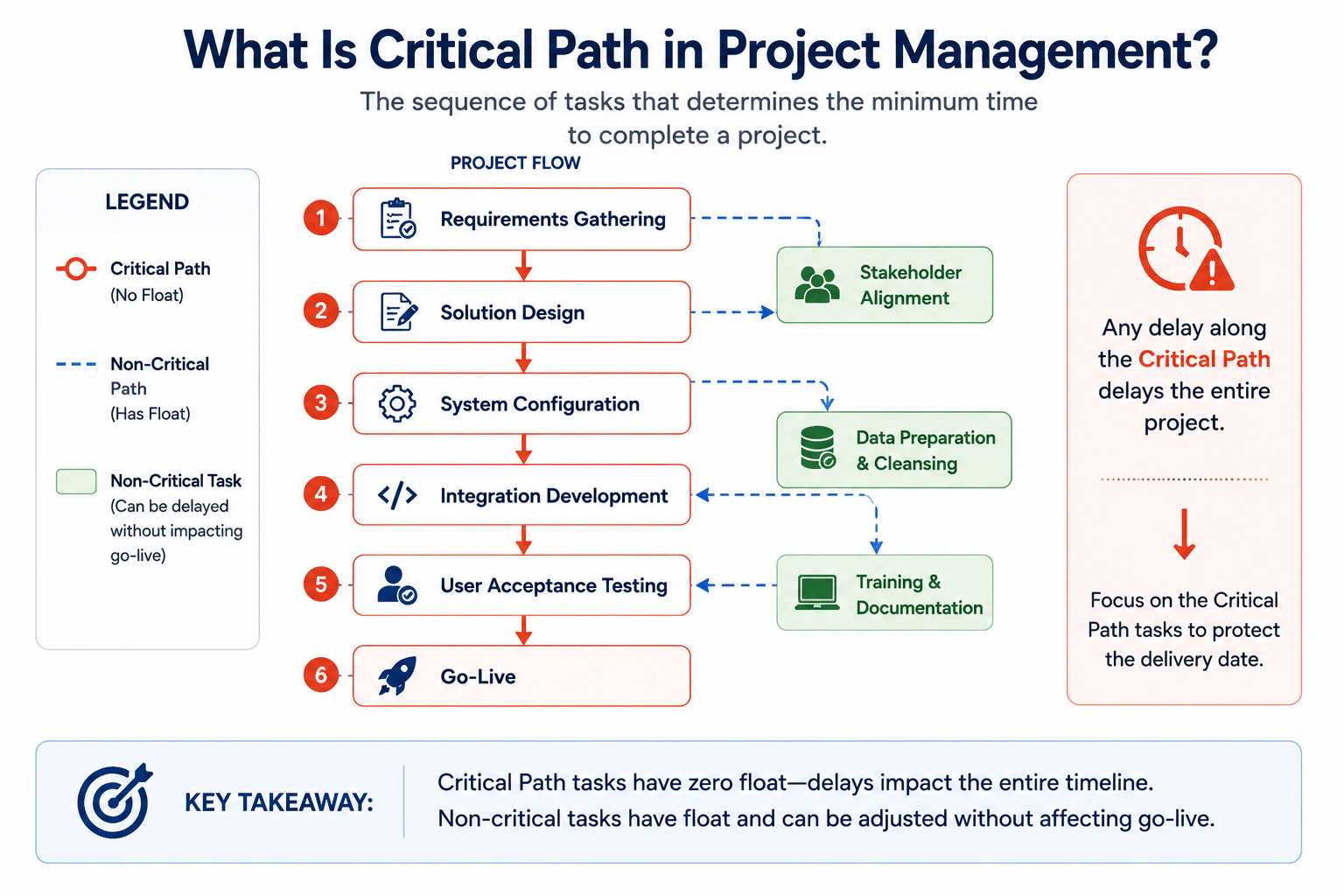
Every project contains many tasks, but not every task directly impacts the final delivery date. Some activities have flexibility. Others do not.
The tasks with little or no scheduling flexibility become part of the Critical Path.
For example, imagine a software implementation project with the following stages:
User testing cannot begin until integrations are complete. Go-live cannot happen until testing is finished. If integration development slips by two weeks, the entire project likely slips by two weeks as well.
That sequence becomes the Critical Path.
The purpose of Critical Path analysis is to help teams identify where delivery risk actually exists so they can prioritize resources, manage dependencies, and prevent delays before they impact project outcomes.
One of the biggest mistakes organizations make is treating all project tasks equally.
In reality, certain tasks matter significantly more because they directly control project completion timelines.
Critical Path management helps teams focus attention on the work that truly drives delivery success. Without it, organizations often spend time optimizing low-impact activities while major dependencies quietly threaten timelines in the background.
The result is familiar to many delivery teams:
Critical Path visibility helps organizations reduce those surprises by exposing the operational bottlenecks that matter most.
At its core, the Critical Path Method is really dependency management.
Most projects do not fail because teams forget the work itself. They fail because one task depends on another task, approval, stakeholder, or system before progress can continue.
In modern organizations, those dependencies are everywhere.
A customer onboarding project may depend on:
Each dependency introduces potential delay risk.
As organizations become more cross-functional, managing those dependencies manually becomes increasingly difficult.
Critical Path management is used across nearly every industry that manages complex projects.
In SaaS onboarding and enterprise software implementation, the Critical Path often revolves around integrations, data migration, security reviews, and customer approvals. A delayed integration or missing requirement can push an entire onboarding timeline off schedule.
In construction, the Critical Path is highly visible. Foundation work, inspections, material delivery, framing, and permitting all operate in tightly connected sequences. A delay in one phase often blocks multiple downstream activities.
Manufacturing organizations use Critical Path analysis to manage supply chain coordination, factory scheduling, and equipment readiness. Pharmaceutical companies rely on it heavily during clinical trials and regulatory approvals where timing directly impacts commercialization.
Across industries, the principle remains the same:
A small number of interconnected activities ultimately determines whether projects finish on time or fall behind.
The Critical Path Method has existed for decades, but modern delivery environments expose major limitations in how organizations traditionally manage it.
Historically, project schedules were relatively static. Teams created project plans at the beginning of delivery and updated them periodically over time.
But modern operations move too quickly for static planning models to remain accurate.
Projects today are highly dynamic:
By the time schedules get manually updated, delivery risk may already be escalating.
This is one of the biggest operational challenges facing PMOs and onboarding organizations today. Traditional Critical Path management often becomes reactive instead of predictive.
Project managers spend enormous amounts of time:
And despite all that effort, risks still surface too late.
The problem is not project managers themselves.
The problem is that humans cannot process the volume of operational signals generated across modern delivery environments fast enough.
Many organizations focus heavily on closing deals, but operational complexity often begins after the contract is signed. Onboarding introduces dozens of moving parts across internal teams and customer stakeholders.
For example:
Every onboarding project contains hidden dependencies that influence delivery speed.
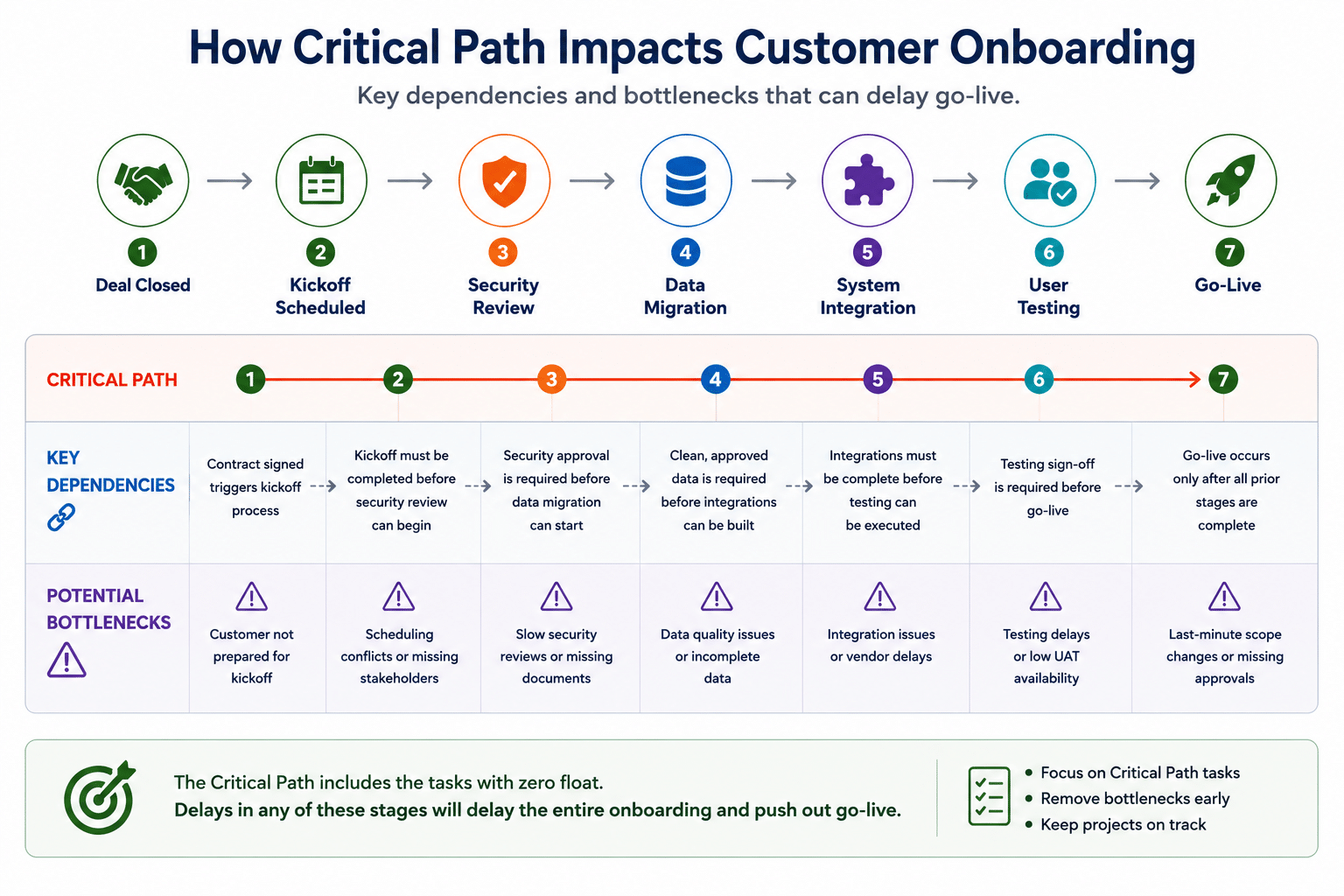
Without Critical Path visibility, onboarding teams often discover blockers only after implementation work has already stalled. A delayed customer approval pushes integrations back. Integration delays postpone testing. Testing delays move go-live dates. Revenue realization slows.
The downstream impact compounds quickly.
As SaaS companies increasingly compete on customer experience and time-to-value, onboarding organizations are realizing they need far greater visibility into dependencies and delivery sequencing.
Historically, Critical Path analysis depended heavily on manual oversight. Project managers were responsible for identifying delays, monitoring dependencies, escalating blockers, and adjusting schedules manually.
AI is beginning to change that model.
Modern AI-powered delivery systems can continuously monitor operational signals across tasks, workflows, communication systems, approvals, timelines, and stakeholder activity.
Instead of waiting for a PM to identify schedule risk manually, AI can surface signals automatically.
For example, AI can detect:
This allows organizations to move from reactive project management toward predictive delivery operations.
Rather than discovering delays after milestones are missed, teams can identify risks before they impact the Critical Path.
One of the biggest limitations of traditional Critical Path planning is that schedules are treated as relatively fixed. But modern delivery environments constantly change.
AI enables a much more adaptive approach. It transforms project management from static scheduling into continuous operational intelligence.
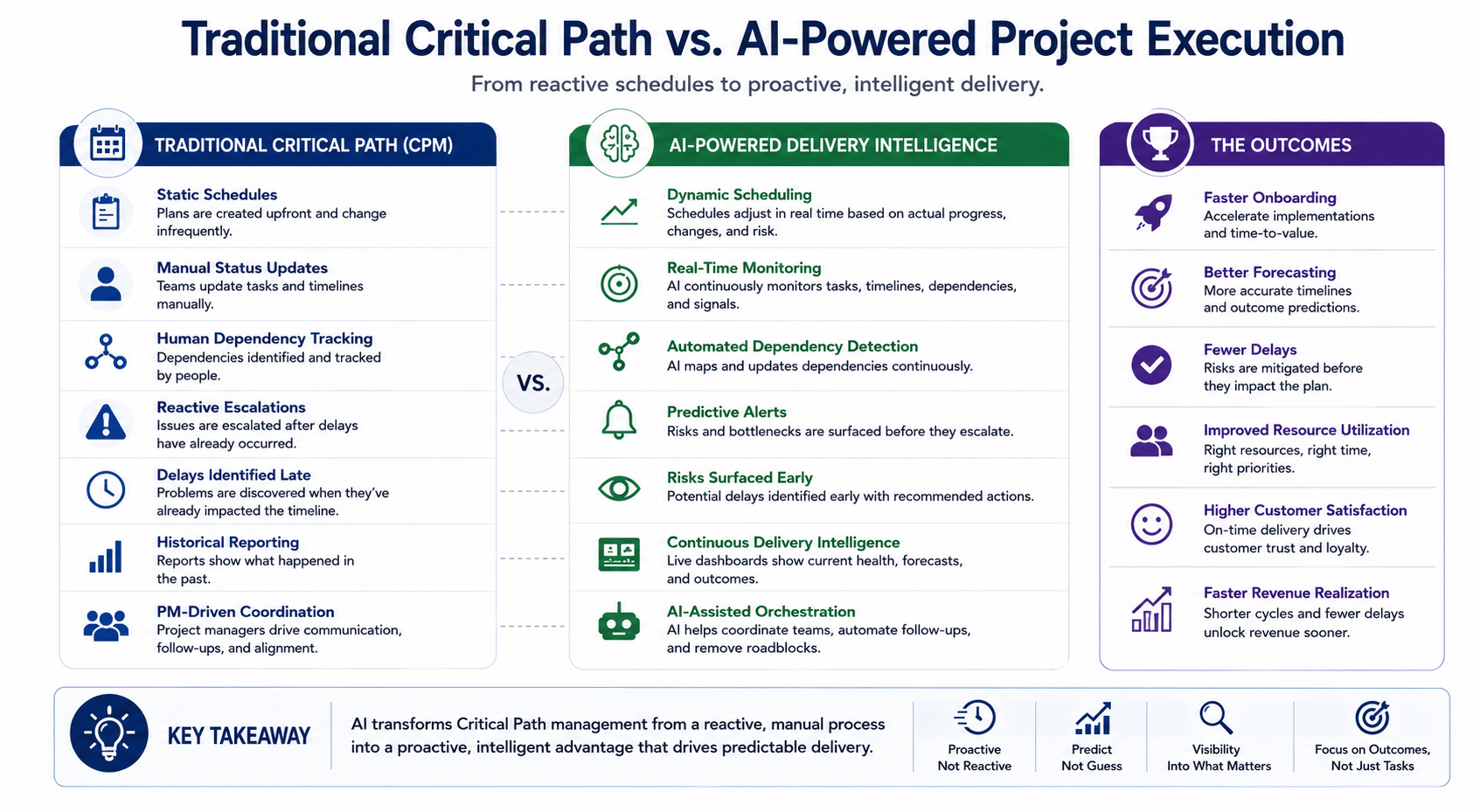
For PMOs, onboarding teams, and implementation organizations, that shift matters because speed and predictability are becoming major competitive advantages.
The Critical Path has always been one of the foundational concepts in project management because every project depends on a small set of activities that ultimately determine delivery success.
But the complexity of modern delivery operations is pushing traditional project management methods to their limits.
Organizations today need better visibility into dependencies, operational bottlenecks, and scheduling risk. That is why AI is becoming increasingly important.
The future of the Critical Path Method is not simply building better project plans.
It is creating intelligent delivery systems capable of continuously monitoring execution, predicting delays, and helping teams adapt in real time.
To learn more about how to apply the Critical Path Method to your project management workflows, explore TaskRay Templates and Automations.

